

The question is IPTV legal has become increasingly common in Canada as more people search for affordable ways to access live TV and on-demand content. IPTV, which stands for Internet Protocol Television, allows users to stream television channels and movies directly over the internet instead of relying on cable or satellite connections. It is fast, convenient, and widely accessible, which explains its growing popularity among Canadian households.
However, the real confusion comes from the legal aspect of IPTV. The technology itself is completely legal in Canada, but the is IPTV legal debate arises because not all services offering IPTV operate within the law. Some providers stream copyrighted content without authorization, which makes their service illegal under Canadian copyright regulations. Understanding the difference between legitimate IPTV services and illegal ones is essential to avoid legal issues and protect your privacy.
In Canada, the legality of IPTV depends entirely on the source of the content. When you subscribe to a licensed provider such as Bell Fibe, Telus Optik TV, Rogers Ignite, or any other service registered with the Canadian Radio-television and Telecommunications Commission (CRTC), you are using IPTV legally. On the other hand, if you purchase a low-cost subscription from an unlicensed website that offers thousands of international channels for a fraction of the price, that service is not authorized and can lead to serious risks.
This guide will clearly explain is IPTV legal in Canada by separating fact from fiction. You will learn how Canadian law defines legal IPTV, what the CRTC’s role is, what penalties exist for using illegal providers, and how to identify legitimate services. By the end, you will have a clear understanding of how to enjoy IPTV safely, responsibly, and fully within the boundaries of Canadian law.
Table of Contents
The Quick Answer: Is IPTV Legal or Illegal in Canada?
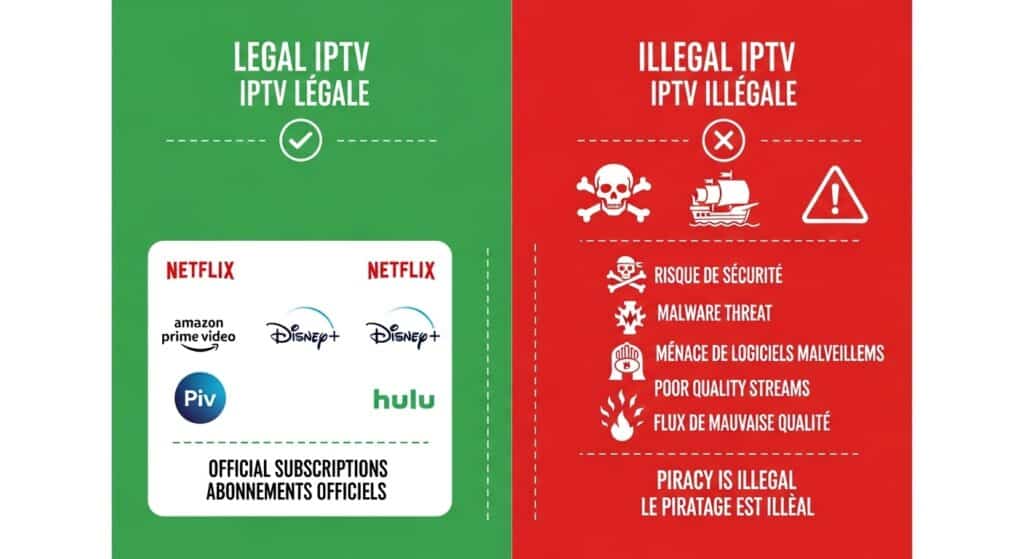
The short answer to is IPTV legal in Canada is yes, but with important conditions. IPTV as a technology is completely legal. It is simply a method of delivering television content through the internet instead of traditional cable or satellite. Many major Canadian providers, including Bell, Telus, Rogers, and Shaw, use IPTV technology for their own television services. When used through an authorized source, IPTV is entirely legitimate and regulated under Canadian broadcasting laws.
However, the question is IPTV legal becomes complicated when users access unauthorized content. The legality depends not on the technology itself, but on the provider and the type of material being streamed. Some services offer thousands of channels, movies, and live sports events at prices that seem too good to be true. These are usually unlicensed platforms that stream copyrighted content without permission. Using such services can expose users to legal, financial, and security risks.
Canadian law, under the Copyright Act, clearly states that distributing or accessing pirated content without authorization is illegal. The Canadian Radio-television and Telecommunications Commission (CRTC) also enforces regulations that protect intellectual property rights. This means that the answer to is IPTV legal varies based on whether the service pays for broadcasting rights and follows CRTC rules.
To summarize, IPTV itself is legal in Canada, but only when it comes from a licensed and regulated provider. If a platform offers thousands of global channels for just a few dollars per month, it is likely operating outside the law. Canadians who want to use IPTV safely should always verify that the provider is recognized by the CRTC or is part of a legitimate streaming network. Understanding this difference is key to staying compliant with the law and avoiding unwanted consequences.
The Canadian Legal Landscape: Understanding What Makes IPTV Legal or Illegal
When discussing is IPTV legal in Canada, it is crucial to look at how the Canadian legal system defines and regulates this technology. IPTV itself is perfectly lawful because it is simply a way of transmitting television signals through the internet using the Internet Protocol. However, the issue arises when content is streamed or redistributed without proper authorization. The CRTC, or Canadian Radio-television and Telecommunications Commission, plays a central role in determining which IPTV services are operating legally within Canada’s broadcasting framework.
Legal IPTV Services Regulated by the CRTC
To fully understand is IPTV legal, we must first recognize that several major television providers in Canada use IPTV technology in compliance with the law. Companies such as Bell, Rogers, Telus, Shaw, and Vidéotron deliver their television services using the IPTV model. These providers pay for the broadcasting rights to distribute channels and on-demand content. They also adhere to Canadian copyright laws and consumer protection regulations.
When you subscribe to one of these CRTC-approved services, you are using IPTV legally. These companies ensure that the content they provide has proper distribution licenses and that the programming is regulated under Canadian law. Therefore, is IPTV legal becomes a straightforward question in this case: yes, it is entirely legal when the service operates with appropriate authorization.
Illegal IPTV and the Canadian Copyright Act
The confusion around is IPTV legal often comes from unauthorized or “grey market” services. These platforms advertise access to thousands of international channels, premium movies, and live sports for a very low price. They do not have distribution rights, which makes their operation illegal under the Canadian Copyright Act.
This law protects content creators and broadcasters by ensuring that their work cannot be distributed or sold without their consent. When users pay for access to these pirated services, they are indirectly participating in copyright infringement. Even though the risk for end users is generally lower than for operators, it still exists. Using such services can result in warnings from Internet Service Providers (ISPs) or even financial penalties.
Why the CRTC Matters in Determining Legality
The role of the CRTC is essential in answering is IPTV legal in Canada. This federal body oversees and licenses legitimate broadcasters and streaming services. It ensures that all providers meet Canadian content requirements, follow broadcasting regulations, and protect the rights of both creators and consumers.
Unlicensed IPTV services, on the other hand, operate outside of this legal framework. They typically host servers in foreign countries to avoid enforcement. As a result, they are not subject to CRTC oversight and cannot be considered lawful in Canada.
In summary, when you ask is IPTV legal, the answer depends entirely on whether the service you use is regulated and authorized by the CRTC. Legal IPTV providers respect Canadian copyright law and broadcasting rules. Illegal services violate these standards and expose users to potential risks. Understanding these distinctions helps Canadian viewers make informed choices and enjoy IPTV without breaking the law.
Consequences of Using Illegal IPTV in Canada
The question is IPTV legal often leads to another important issue: what happens if someone uses an illegal IPTV service in Canada? Many people are unaware that there are real legal and security risks associated with unlicensed streaming. While authorities usually focus on prosecuting sellers and distributors of pirated content, users can still face consequences if they knowingly access illegal IPTV streams. Understanding these risks is essential for anyone who wants to make informed decisions about watching television online.
ISP Warning Letters and Detection
One of the first things to understand when asking is IPTV legal is that Internet Service Providers (ISPs) in Canada can detect suspicious activity related to illegal streaming. Under the “Notice and Notice” regime established by Canadian law, ISPs are required to send warning letters to users who may be involved in copyright infringement. This means that if someone streams copyrighted material from an unauthorized IPTV provider, their ISP might send a notice reminding them of the legal risks.
These warning letters do not usually lead to immediate prosecution, but they are a clear indication that the user’s activity has been monitored. Repeated notices could result in increased scrutiny, potential disconnection, or referral to authorities. This system is designed to educate consumers and discourage participation in illegal IPTV activities while still respecting user privacy.
Fines and Legal Penalties
Another critical aspect of is IPTV legal relates to fines and legal penalties. The Copyright Act of Canada makes it illegal to distribute or profit from copyrighted material without permission. While users are rarely fined for personal use, the law technically allows for penalties that can reach several thousand dollars in serious cases. More importantly, those who resell IPTV subscriptions or host illegal servers can face severe financial and criminal consequences.
In past Canadian cases, authorities have focused on dismantling illegal IPTV networks and prosecuting the individuals who operate them. These actions show that while end users may not always be directly targeted, they are still participating in an unlawful system that supports piracy. By choosing legal IPTV services, viewers avoid any involvement in potential copyright violations.
Cybersecurity and Privacy Risks
A less visible but equally serious issue when exploring is IPTV legal involves cybersecurity. Many illegal IPTV services are hosted on unsecured or malicious servers. These sites often require users to install applications or enter payment details that are not protected by encryption. As a result, personal information such as credit card data, passwords, and even device access can be compromised.
Cybersecurity experts in Canada warn that illegal IPTV services are frequently used as entry points for malware, spyware, and phishing scams. Once installed on a device, this software can collect sensitive data or even take control of a system remotely. Using a legal, CRTC-approved IPTV provider prevents these risks entirely and guarantees compliance with privacy laws.
The Real Cost of Illegal IPTV
Ultimately, the answer to is IPTV legal depends on whether users choose to follow the rules. Illegal IPTV might seem attractive due to its low cost and wide selection of channels, but it comes with hidden dangers. Between the risk of ISP warnings, potential legal penalties, and serious cybersecurity threats, the long-term consequences far outweigh the temporary savings.
By choosing legitimate IPTV services, Canadians can enjoy reliable, high-quality entertainment while respecting the law. It is always safer and more responsible to invest in licensed providers that protect users and uphold Canadian broadcasting standards.
How to Identify Legal and Illegal IPTV Services in Canada
For Canadians wondering is IPTV legal, the best way to stay compliant is to know how to tell the difference between legal and illegal providers. Many websites and resellers claim to offer legitimate IPTV subscriptions, but not all of them follow Canadian law. Fortunately, there are several clear signs that can help users determine whether a service is authorized or operating in a grey area. Understanding these indicators can prevent legal problems, protect your personal information, and ensure a safe viewing experience.
Checklist: Legal vs. Illegal IPTV
The simplest way to evaluate is IPTV legal for a specific service is to go through a checklist of red flags and compliance indicators.
| Criteria | Legal IPTV (CRTC Approved) | Illegal IPTV (Grey Market) |
|---|---|---|
| Channel Count | Offers a realistic range of regional and licensed channels, typically 100 to 300. | Promises access to 10,000 or more channels from multiple countries. |
| Price | Market-based pricing, often $40 to $80 per month. | Extremely low pricing, usually under $20 per month. |
| CRTC Registration | Provider is licensed or affiliated with a regulated broadcaster such as Bell, Rogers, or Telus. | Provider is unregistered, with no official affiliation or license. |
| Payment Methods | Accepts credit cards or verified platforms like PayPal. | Only accepts cryptocurrency or anonymous transfers. |
| Transparency | Clearly displays terms, conditions, and company contact information. | Hides ownership details and uses vague or missing legal notices. |
This checklist is one of the most effective tools to help answer is IPTV legal for a given provider. Any service that fails multiple criteria on this list is likely operating outside Canadian law and should be avoided.
Common Red Flags to Watch Out For
When evaluating is IPTV legal, pay attention to the service’s marketing and structure. Illegal IPTV providers often advertise unrealistic offers such as access to every global sports channel or pay-per-view events for a minimal fee. They may also claim to provide “private servers” or “exclusive content,” which are common phrases used by unauthorized distributors.
Another major warning sign is the absence of a proper refund policy or customer support. Legal IPTV companies in Canada are required to offer clear customer service contact details and secure payment options. Grey market services usually disappear after a few months, leaving users without access or compensation.
If the provider does not mention the CRTC, avoids using its official logo, or refuses to disclose its operating location, it is almost certainly not legal. Checking online reviews and verifying domain registration details can also help confirm the legitimacy of a service.
Examples of Legal IPTV Providers in Canada
To fully understand is IPTV legal, it helps to look at examples of legitimate services. Major telecommunications companies such as Bell Fibe TV, Rogers Ignite TV, Vidéotron Helix, and Telus Optik TV are fully regulated by the CRTC. They hold broadcasting licenses, pay copyright fees, and offer customer protection in line with Canadian law.
Additionally, some international streaming services such as FuboTV, DAZN, and Apple TV+ also operate legally in Canada. They follow distribution agreements and are recognized by local regulations. Any IPTV provider outside these categories should be examined carefully.
The Importance of Transparency and Licensing
When asking is IPTV legal, one of the clearest indicators is whether the provider publicly displays licensing information. Legal IPTV providers are transparent about their operations and openly state that their content distribution complies with copyright laws. Illegal services, in contrast, hide behind anonymity to avoid legal accountability.
The best approach for Canadians is to verify that a provider is either directly licensed by the CRTC or affiliated with an authorized broadcaster. By doing so, users can enjoy IPTV safely while respecting Canadian law and avoiding potential fines or data breaches.
Understanding these distinctions allows viewers to confidently answer is IPTV legal for themselves and make informed decisions about which services to trust.
How to Stay Safe and Private While Using IPTV in Canada
When exploring is IPTV legal, one important aspect often overlooked is online privacy and security. Even users who choose legal IPTV services should take steps to protect their personal data and maintain a stable streaming experience. Internet Service Providers in Canada sometimes monitor or throttle connections when large amounts of data are used for streaming. For this reason, many Canadians rely on VPNs to ensure a safer and smoother IPTV experience.
Why a VPN Is Important for IPTV Privacy
A Virtual Private Network, or VPN, encrypts your internet traffic and hides your IP address. This ensures that no one, including your ISP, can easily track your online activity. For users asking is IPTV legal, using a VPN adds an essential layer of security. Even if you only access licensed IPTV services, a VPN helps protect your privacy from data collection and third-party monitoring.
VPNs are completely legal in Canada, and their use is encouraged for maintaining confidentiality. A good VPN allows users to watch IPTV without revealing their location or risking exposure to data theft. It also helps avoid accidental access to unauthorized content hosted outside Canadian jurisdiction.
Avoiding ISP Throttling and Buffering
One of the biggest frustrations for IPTV viewers is buffering. Many ISPs limit or “throttle” bandwidth for streaming services, which leads to slow or unstable video playback. Using a VPN prevents this issue by encrypting traffic so that ISPs cannot identify streaming data. When applied properly, a VPN maintains consistent speed and eliminates interruptions.
For users researching is IPTV legal, this becomes especially useful because even legitimate IPTV providers rely on stable internet connections. Without a VPN, your ISP can interfere with your stream, reducing quality and causing lag. VPN protection ensures a reliable and private viewing experience for all types of IPTV content.
Accessing Geo-Restricted Legal Content
Another advantage of a VPN for those asking is IPTV legal is the ability to access geo-restricted services. Some legal IPTV and streaming platforms only allow certain shows or sports events to be viewed in specific regions. With a VPN, users can connect to servers in other Canadian provinces or countries where the content is available.
This is particularly useful for Canadians who travel abroad but want to continue using their legal IPTV subscriptions. It allows access to the same channels and on-demand content available at home without violating any rules. VPNs simply create a secure tunnel that connects you to your existing legal service safely and privately.
Choosing a Trusted VPN Service
If you are still wondering is IPTV legal, pairing your IPTV provider with a reputable VPN is the smartest decision. Not all VPNs offer the same level of protection or speed. For IPTV, it is best to choose a provider with high-speed Canadian servers, strict no-log policies, and strong encryption standards.
Well-known options such as NordVPN, Surfshark, and ExpressVPN are popular among IPTV users because they maintain privacy, bypass throttling, and ensure fast streaming quality. They also comply with Canadian laws, making them ideal companions for legal IPTV services.
The Bottom Line on Security and IPTV
In conclusion, using a VPN is not a method to bypass laws but a way to protect personal data and improve the IPTV experience. For anyone wondering is IPTV legal, it is vital to remember that legality depends on the content source, not the technology. Combining a licensed IPTV provider with a trusted VPN ensures you enjoy high-quality entertainment while keeping your privacy intact.
This approach allows Canadians to benefit from IPTV technology responsibly and confidently, knowing they are secure, compliant, and protected online.
Conclusion and Final Verdict on IPTV Legality in Canada
After analyzing all aspects of is IPTV legal, it is clear that the answer depends on how the service is provided and consumed. IPTV as a technology is completely legal in Canada, but the way it is used determines whether it complies with the law. Legal IPTV services operate under the supervision of the CRTC, pay for broadcasting rights, and protect user data. Illegal IPTV services, on the other hand, stream copyrighted material without permission and expose users to serious legal and cybersecurity risks.
The question is IPTV legal often arises because of the confusion between legitimate services like Bell Fibe TV, Telus Optik, or FuboTV, and grey-market providers that promise thousands of global channels at suspiciously low prices. While the technology itself is not prohibited, accessing pirated or unauthorized content through unlicensed sources violates the Canadian Copyright Act. Users should always verify that their provider is registered or compliant with Canadian regulations before subscribing.
The Safest Way to Use IPTV in Canada
For Canadians asking is IPTV legal, the safest approach is to stick with official providers and authorized resellers. These companies ensure high-quality streams, protect user privacy, and comply with all broadcasting regulations. Subscribing to unlicensed IPTV services might seem cheaper in the short term, but the potential consequences include receiving ISP warnings, facing financial penalties, or suffering data breaches.
Using a reliable VPN can enhance your online security, but it does not make illegal streaming lawful. A VPN simply provides encryption and privacy protection, which are beneficial even when using fully legal IPTV services. Combining a legitimate IPTV provider with a strong VPN ensures that your streaming experience remains safe, private, and uninterrupted.
Final Thoughts on IPTV and the Law
So, is IPTV legal in Canada? The final answer is yes, as long as you choose licensed platforms and respect copyright laws. IPTV is transforming how Canadians access television, offering flexibility, convenience, and high-quality digital broadcasting. However, users must remain vigilant about the services they use and understand the difference between legal and illegal sources.
By staying informed and following CRTC-approved providers, Canadians can enjoy all the advantages of IPTV without risking fines or security issues. When handled responsibly, IPTV is not only legal but also one of the most efficient and innovative ways to enjoy entertainment in 2025.
FAQs About IPTV Legality in Canada
Is the IPTV box itself illegal in Canada?
No, the hardware is legal. What matters is how it is used. If the IPTV box accesses unauthorized content, that use becomes illegal.
Can I get fined for using illegal IPTV?
While most enforcement targets sellers and distributors, users who knowingly stream pirated content can still face warnings or penalties under the Copyright Act.
Is using a VPN with IPTV legal?
Yes, using a VPN is completely legal in Canada. It enhances privacy and security but does not make illegal IPTV services lawful.
Which IPTV providers are fully legal in Canada?
Services like Bell Fibe TV, Telus Optik, Rogers Ignite TV, Vidéotron Helix, and FuboTV are legitimate and regulated by the CRTC.
What is the main takeaway about IPTV legality?
The answer to is IPTV legal depends on your provider. Stick to licensed, transparent, and regulated platforms to stay safe, legal, and protected while streaming online.